
Deep Winter
Deep Winter suits people whose features come alive in saturated cool tones, darker shades, and crisp contrast.
- Temperature
- Neutral, leaning cool
- Depth
- Deep
- Clarity
- Bright
- Best metal
- Silver, platinum, gunmetal
- Best neutral
- Black
- Also called
- Dark Winter
Not sure this is you? Take the three-question season quiz or check your undertone.
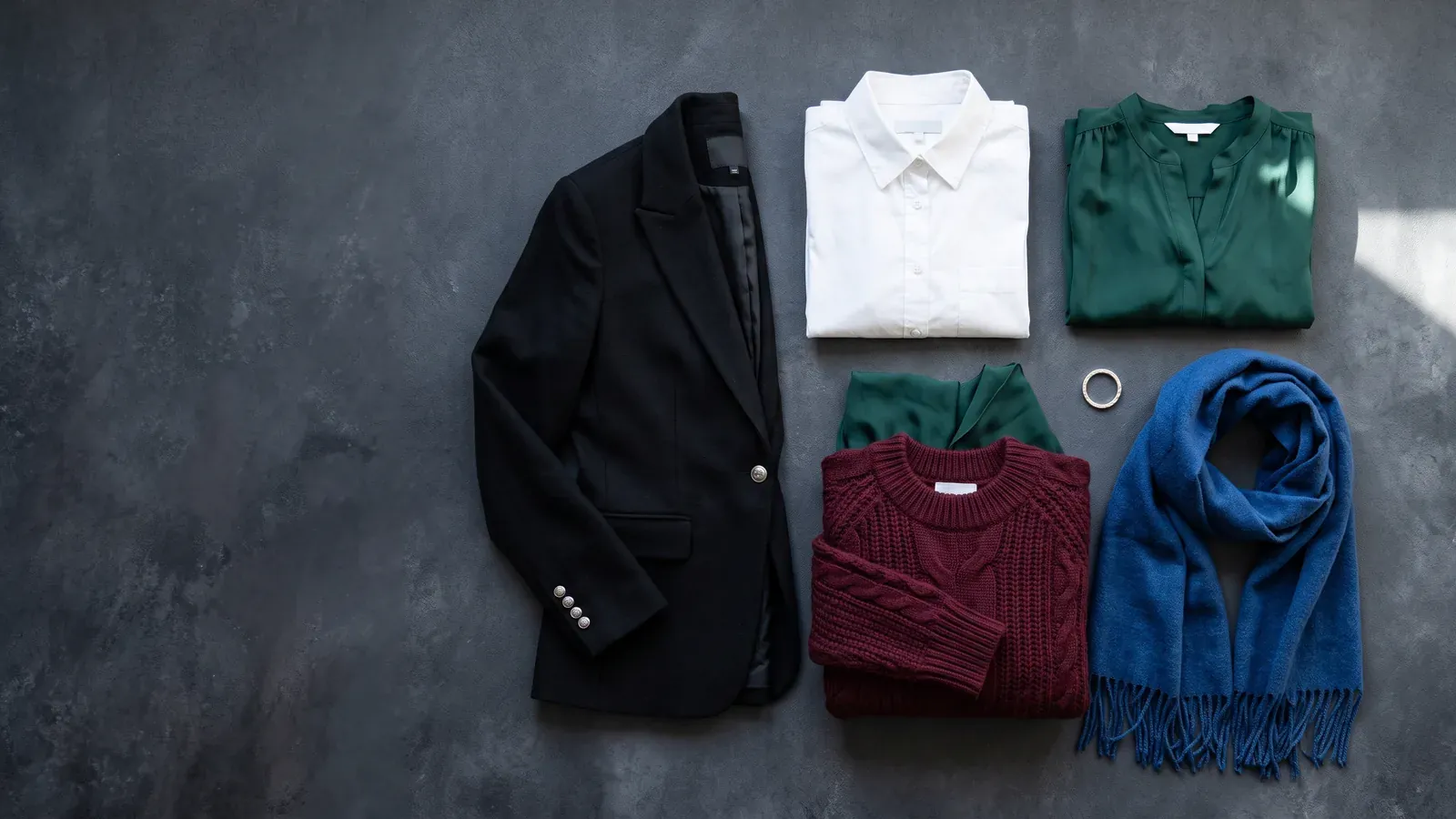
Deep Winter signature colors
- Deep Burgundy
- Deep Emerald
- Dark Violet
- Deep Cherry
- Sapphire
Best neutrals
- Pure White
- Dusty Chocolate
- Charcoal
- Deep Charcoal
- Deep Espresso
Accents
- Pale Lavender
- Icy Steel Blue
- Icy Periwinkle
- Light Blush
- Pale Rose Pink
All 60 Deep Winter colors with HEX codes, plus free swatch files
Deep winter is a cool, dark season: it suits you if rich, moody shades and bold contrast make you look your best.
Picture black, wine-deep burgundy, or sapphire. Of the three winter seasons, this is the darkest. Depth is your strongest trait, with coolness close behind, so your coloring looks rich and dark rather than icy. You probably fit this season when dark hair and dark eyes team up to give you high contrast. Contrast simply means the distance between your lightest and darkest features: and yours is wide. That's why pure black near your face looks sharp on you, never harsh.
Deep Winter color analysis: how to tell
- Your skin looks clear and smooth with black held right under your chin
- Your face turns pale and washed out in light pastel colors
- Your skin takes on a yellow or muddy look beside golden brown and warm orange
- Your face brightens with dark berry lipstick, never like too much makeup
- On your skin, yellow gold looks less clean than dark gunmetal and silver jewelry
Deep Winter (Dark Winter) characteristics: skin, hair and eyes
Skin tones in deep winter
Skin here spans everything from porcelain-fair to the deepest tones. The common thread is a cool or neutral-cool undertone paired with dark hair and eyes. Common looks include:
- fair beige or pale ivory, both cool-toned
- olive from light to medium, neutral and cool
- medium tan with a bronzy cool undertone
- espresso-deep brown skin showing cool red or blue beneath
A few patterns show up across every one of them. Black worn just under your chin keeps skin looking fresh and even. Silver and dark gunmetal jewelry look cleaner on your skin than yellow gold. Shades like warm orange and golden brown, though, can leave your skin looking dull or muddy.
Eyes in this season
Eyes here tend to be deeply dark and crystal clear. Plenty of people in this season carry a bold dark ring around the iris, and it deepens the whole face. Shades you'll often see:
- black brown or a deep espresso
- cool dark brown melting into the pupil
- dark hazel ringed in cool green or grey
- deep olive green with a dark rim
Hair you were born with
Hair in this season runs dark, with no red highlights. Jet black with a cool or blue gleam might be your shade, as might soft black or an espresso-deep brown. Ash brown in its darkest form and deep cool brown, the near-black kind, belong here too.
- blue sheen or a cool cast on jet black
- deep espresso brown or soft black
- no red highlights on dark ash brown
- reads almost black while staying deep cool brown
Why do people also call it dark winter?
Dark Winter is another name for this same season. Whether you say "deep" or "dark," you're pointing at the same core trait: the deep tone running through your hair, eyes and whole coloring.
As for winter, that half of the name comes from your undertone: the subtle cast beneath your skin's surface. Here the lean is cool rather than golden. Your undertone is often neutral cool rather than fully cool. Heavy darks flatter you for that reason, while warm orange can give your skin a yellowish cast.
Colors that suit a deep winter
Deep, shadowy shades match the depth you were born with, and cool tones keep skin looking clear. Each season's palette on the site lists 60 colors by name, grouped under neutrals, main colors and accents. Below are 5 signature shades to start with:
- Deep burgundy: lovely on tops that sit near your chin
- Deep emerald, which makes dark eyes pop
- Dark violet, a bold pick for evenings
- Deep cherry: a red with a cool base that stays cool against your skin
- Sapphire, a rich clear blue
For basics, true black and pure white come easily to you. Rather than plain brown or grey, reach for deep espresso, dark pine or deep charcoal.
Light accents shine in small doses: a scarf, or a shirt worn beneath a dark jacket. Your full palette page shows which lighter shades work best as small touches. For makeup, dark berry lipstick tends to wake up your face without feeling like too much.
How to tell deep winter from its close neighbours
There are 3 neighbouring seasons that people often confuse with this one. Each pairing comes with a quick test you can run in front of a daylight mirror.
Deep Autumn versus Deep Winter
Both of these seasons call for rich, dark colors near the face and lose their spark in pale pastels. To separate them, hold dark chocolate brown against pure jet black. If dark brown and bronze warm up your skin while pure black leaves shadows under your eyes, you're Deep Autumn. If pure black and silver give your features a crisp edge while dark brown goes muddy beside your face, that points to Deep Winter.
Cool Winter versus Deep Winter
Both share a cool undertone that stays crisp against black, white and silver. Place dark burgundy beside bright royal blue with icy pink. If wine-dark burgundy and gunmetal sit right at your natural depth, while icy pink and royal blue come off too frosty, think Deep Winter. If royal blue and icy pink clarify your skin while heavy burgundy weighs your face down, you're Cool Winter.
Bright Winter versus Deep Winter
Both run neutral-cool underneath and carry strong contrast much more gracefully than muted pastels. Put crisp snow white and bright cyan up against dark plum and black. If dark plum and black harmonize with your rich coloring while bright cyan feels too loud, you're Deep Winter. If snow white and cyan illuminate your face while all-dark plum feels heavy, you're Bright Winter.
Deep Winter worst colors to skip
Pale pastels worn alone tend to drain you and leave your face looking washed out. Warm or dusty tones also fight against the cool side of your coloring. Skip these above all:
- Bright copper
- Pale coral
- Soft coral
- Dusty apple green
- Mahogany
- Bright Copper#D56400
- Pale Coral#FFC4B5
- Soft Coral#DA8F7C
- Dusty Apple Green#90B07F
- Mahogany#742F25
Deep Winter (Dark Winter) for men
- Suits, coats and trousers
- Pure White
- Dusty Chocolate
- Charcoal
- Deep Charcoal
- Shirts and knitwear
- Deep Burgundy
- Deep Emerald
- Dark Violet
- Deep Cherry
- Ties, socks and pocket squares
- Pale Lavender
- Icy Steel Blue
- Icy Periwinkle
- Light Blush
Often confused with Deep Winter
Questions people ask
Why might my deep winter skin look olive or warm?
Plenty of people in this season do have light to medium olive skin. Olive skin usually carries a neutral-cool undertone, so a faintly warm surface look is nothing unusual. Try black and then dark brown near your face in daylight: that comparison tells you more than your skin's surface look alone.
How can the quiz place my season with no photo?
Phone cameras and household bulbs both skew skin color, so a selfie can point you the wrong way. Instead, the quiz walks you through 3 checks: gold versus silver, how light or deep your features are, and whether crisp-bright or gentle-soft colors do more for your face. Nothing gets uploaded, and no email or account is needed: your answers never leave the browser.
Can I trust a quiz result on its own?
Think of a quiz as a first clue. Daylight mirror checks can confirm it, and so can an in-person draping session.