
Color analysis
Color analysis is a way of styling that picks clothes and makeup shades to go with your own skin, eyes and hair.
Take the free three-question quiz
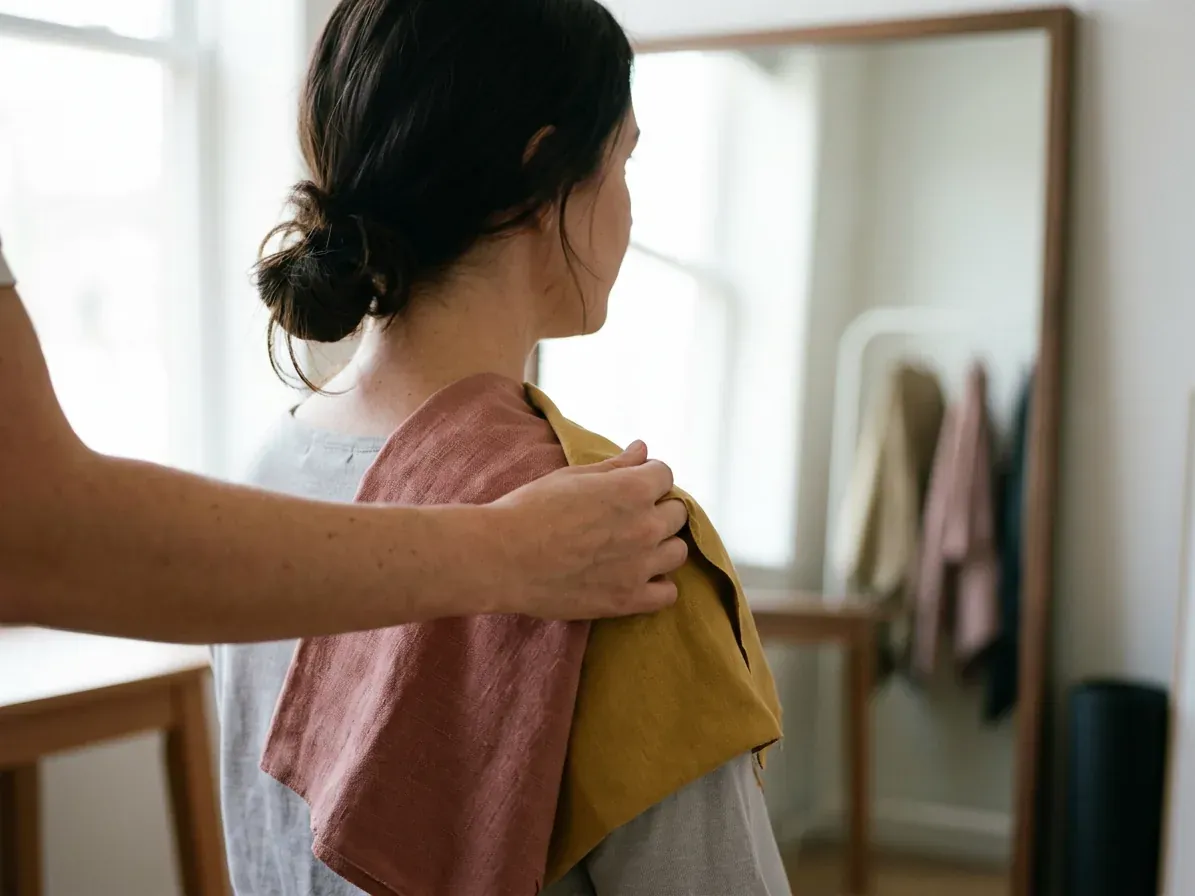
It's not medicine and it's not a lab result. It works because of something you can see: when you hold a color up to your face, it changes how smooth your skin looks, how harsh your shadows seem and how bright your eyes appear. At a glance: 12 seasons, a free three-question quiz, and professional sessions that typically cost $100 to $800, depending on the format.
Color analysis types: the seasonal families
Seasonal analysis sorts your natural coloring into four groups, one for each time of year: spring, summer, autumn and winter. Every group breaks down further into three seasons, giving 12 seasons in total. Whichever one is yours takes its name from the trait that stands out most: light, warm, cool, bright, soft or deep. To find yours, we look at three things: temperature, depth and clarity. Temperature tells you whether gold or silver tones suit your coloring better. Depth is about how light, medium or deep your features are. Clarity asks whether clear, bright shades or gentler, muted ones flatter you more near the face.
One famous method goes by the name Sci\ART. The late Kathryn Kalisz created this 12-tone system in 2000. It maps where a person's natural coloring sits within a three-dimensional space built on hue, value and chroma. Her thinking was shaped by two earlier colorists, Johannes Itten and Albert H. Munsell. As you explore, you may also run into other outfits in the field, such as House of Colour, Color Me Beautiful and Colorwise.
Try our free color quiz at home
Want to try colour analysis free? Our home quiz is three short screens with one question on each. The first asks gold or silver; the second asks whether your features run light, medium or deep; the third asks whether bright or soft colors suit you better near your face.
The season you land on comes with a link to its palette. There are no pictures to send, no signing up, no photo taken of you, and nothing asked for your inbox: everything you answer stays in your browser.
A quiz is a good place to start, not the final word. If you'd like to be sure, check the result with a mirror in daylight, or book an in-person draping session, where someone holds colored fabrics under your chin in daylight and watches how your face responds. An in-person draping session gives you another way to check your result; the quiz is free.
We offer other free tests as well: undertone, skin tone, which colors suit you, which hair color fits you best, and gold or silver.
DIY color analysis: how to do your own
You can test the idea yourself with a few pairs of fabrics or clothes you already own. Stand near a window in daylight, wear no makeup and tie your hair back, so nothing extra casts color onto your face.
Hold each pair under your chin, one shade at a time: gold and silver, black and dark brown, cobalt and dusty rose, stark white and cream. For each pair, pick the shade that flatters you: the one that evens out your skin and brings a sparkle to your eyes. Our quiz asks about the same three things in the same order: temperature, depth, then clarity.
Free AI and virtual color analysis apps
Apps and photo tools that use AI start from a selfie. The problem is that camera white balance, room lighting, screen color and makeup all shift the skin in the picture. The same face can land on different seasons from one attempt to the next.
That's why our quiz asks you questions and suggests a quick daylight mirror check instead of a selfie, so you never need to take a photo.
What does a color analysis service cost?
Seeing a stylist or color consultant in person usually costs $200 to $800, depending on how experienced and well known they are. Online services built on questionnaires, photos and software usually run $100 to $300.
| Type | Typical cost |
|---|---|
| Meeting in person | $200 to $800 |
| Working online | $100 to $300 |
The price also shifts with where the consultant works, how much the session covers (your palette, plus makeup and style tips) and extras like a wardrobe review or a personal shopping trip.
With an online analysis, you snap clear, well-lit photos just as the analyst guides you. They compare your pictures with digital swatches and send your palette back afterward. One studio we found promises it within 14 days.
Color analysis for men
The same 12 seasons apply to men too. The effect shows up most in what you wear near your face (shirts, ties, knits and suits) and even in a watch or a ring's metal. Every season page here has a short men's section with suit, shirt and accent shades taken from your season.
Questions people ask
Is color analysis real?
Think of it as styling rather than science. A color held beside your face may make your skin look more even and your eyes look brighter; try two fabrics in daylight and see what you notice.
What comes in a season palette?
Every season palette has 60 named colors, each with a HEX code, which is a short code that tells a screen exactly which shade to show. The colors are sorted into three sets (neutral shades, main colors and accents) and you'll also see which colors to steer clear of. You can download a palette card (PNG), a color list (CSV), Adobe swatches (ASE) and two Procreate swatch files, or all 12 seasons in one zip.
How can color analysis guide your wardrobe and fashion?
Reserve your palette's neutrals for the big pieces, like coats, trousers and suits. Wear main colors in tops near your face and save accents for small items. Our outfit pages offer five color formulas for each season.