
What colors look good on me?
If you're asking what colors look good on me, the answer comes down to three things: your skin's undertone, how light or dark your natural hair is, and whether your eyes look clear and sparkly or soft and blended.
1 of 3
Not sure? Gold suits warm, silver suits cool.
Pick an answer to go on.
2 of 3
Pick an answer to go on.
3 of 3
Pick an answer to go on.
Colors by undertone
Warm undertone Yellow gold, copper and bronze
- Cream
- Tan
- Peach
- Coral
- Terracotta
- Mustard
Cool undertone Silver and white gold
- Pure White
- Soft White
- Dusty Rose
- Lilac
- Berry
- Sapphire
Neutral undertone Silver, pewter, rose gold and soft gold
- Soft White
- Mushroom
- Dusty Rose
- Watermelon
- Rosewood
- Sage
Olive undertone Brushed gold, pewter and antique silver
- Sage
- Rosewood
- Deep Jade
- Cream
- Soft Teal
- Espresso
Answer one question for each and you'll get a season family plus a set of 12 swatches.
- Questions: 3, shown one at a time
- Result: your season family plus 12 swatches
- Photo: not required
How to know what colors look good on you
Warmth, depth and brightness are already mixed into your skin, hair and eyes. When your clothes repeat that same mix, your face lights up. Colors that don't fit can throw dark shadows on your face or leave your skin looking dull and gray.
First you'll answer a question about your undertone. That's the steady gold or pink cast sitting just under the surface of your skin. Golden yellow and olive tend to make warm skin look healthy. Navy and berry tend to make cool skin glow.
Next comes a question about the depth of your natural hair, anywhere from blonde to black. Combined with your skin, this gives your contrast, which is the size of the gap between your lightest feature and your darkest one. Fair skin with dark hair is high contrast and can pull off deep burgundy. Lighter hair has a gentler blend and often goes well with soft sky blue or peach.
The last question asks if your eyes seem crisp and bright or muted and softly blended. Pure shades make clear eyes shine, while dusty tones give soft eyes a calm feel.
Clarity: bright colors or soft ones
Clarity means what separates a vivid, pure shade from a muted, dusty one that has some gray in it. Bright coral next to dusty rose shows it well, and so does emerald next to sage.
If your features are clear, you need crisp shades, since muddy tones can wash the color out of your cheeks. Soft features are the opposite. Colors that are too loud can swamp soft coloring, and people end up seeing the shirt before they see you.
Reading your result
Your 3 answers land you in one of the 4 season families: spring, summer, autumn or winter. The 12 swatches you get match your own warmth, depth and clarity. Keep them saved on your phone and you'll find it easy to pick out your shades while shopping.
Every family contains 3 seasons, so 12 seasons exist in total. Each season is named for its strongest trait, like light, warm, cool, bright, soft or deep. That's how 2 people can share a family and still need different colors:
- Cool Summer: blues, roses and plums, softened a touch and kept at a medium depth, with no warmth.
- Soft Summer: quiet, greyed shades like slate and sage, made for gentle coloring and low contrast.
- Bright Spring: clean, warm shades worn with strong contrast.
- Deep Autumn: deep, earthy tones suited to dark hair, dark eyes and warm skin.
Think of your 3 answers as a first step. The full season quiz pinpoints which of the 12 seasons is yours. It connects to a palette of 60 named colors sorted into 3 groups: neutrals, main colors and accents. Every palette also tells you which colors to skip.
Mistakes that change your result
Dyed hair is the most common slip. Answer for the shade that grows in at your roots, because that's your natural hair color.
Freckles and rosy cheeks can throw off the first step too. Redness sits on the surface of your skin and says nothing about your undertone. Check colors beside your face in daylight rather than relying on surface redness or a phone photo.
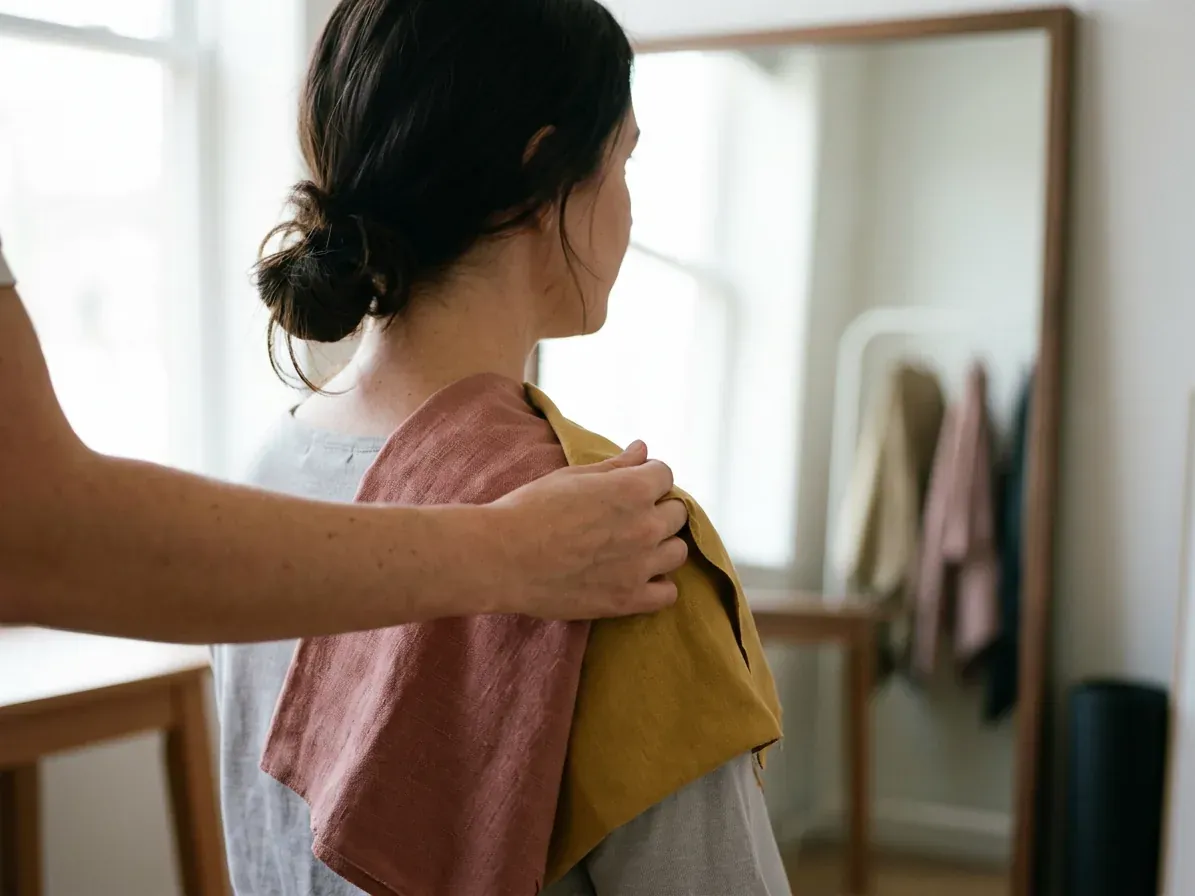
Mirror test with 2 tops
You can test your swatches yourself at home. Grab 2 tops from opposite ends of the color wheel, for example one warm olive and one cool royal blue.
- Face a window in natural daylight, with bare skin and no makeup on, so nothing gets in the way of your true coloring.
- Tie your hair away from your face. If it's dyed, cover it with a white towel to keep the dye from pulling your eye.
- Put the olive top beneath your chin, then swap in the royal blue one.
- Look at your face, not the fabric. A shade that works makes your skin look smoother, while a bad one brings out shadows or makes your lips look gray.
Which colors belong near your face?
Tops, scarves and lipstick sit closest to your face, so your 12 swatches matter most there. Pants and shoes are up to you, since they sit too far away to put shadows on your chin.
More daylight mirror checks can confirm your season. Draping is another option. That's a session in person where someone holds colored fabrics under your chin one at a time.
Your three answers and the season they point to
| Season | Answers that lead there |
|---|---|
| Light Spring |
|
| Warm Spring |
|
| Bright Spring |
|
| Light Summer |
|
| Cool Summer |
|
| Soft Summer |
|
| Soft Autumn |
|
| Warm Autumn |
|
| Deep Autumn |
|
| Deep Winter |
|
| Cool Winter |
|
| Bright Winter |
|
Colors by skin, hair and eyes
Questions people often ask
How do I know what colors suit me if I have a tan or surface redness?
If a tan or redness makes the first question hard to answer, compare colors near your face in daylight and treat the result as a starting point.
Why is there no option to upload a photo of my face?
Cameras in phones change color by themselves, and indoor bulbs add a yellow or blue cast to your skin. Either one can nudge a selfie toward the wrong season. There's no upload, email or account either, and your answers stay in your browser.
Will my season shift once my hair goes gray?
If your hair has gone gray, try the daylight mirror check again and use the full season quiz to explore your palette. A quiz is a starting point, and a mirror check or a draping session can confirm the result.
Is black off-limits if it's missing from my 12 swatches?
Pure black shows up in the winter palettes, such as Cool Winter. On warmer or softer coloring it can feel heavy near the face. If you love it, wear it away from your face, such as pants or shoes, and put a color from your palette near your chin.